Family business advisory
What Is Succession Planning? A Plain Guide for Family Businesses
Most founders have a will. Very few have a succession plan. They are not the same thing.
In short: Succession planning is the process of preparing who will own, lead and carry on a business after the founder steps back. In a family business, it covers ownership, leadership, the family's agreement and the readiness of the next generation. It is a process that takes years, not a document signed in a day.
What is succession planning?
Succession planning answers one question. Who will own this business, and who will run it, when the founder steps back?
That sounds simple. In a family business, it is not, because four questions sit inside it.
Who will own it? Who holds the shares, and in what share.
Who will lead it? Who makes the final decision, every day.
Does the family agree? Parents, children, spouses and siblings are all affected, and all of them need to know.
Are they ready? Skills, trust and the right to decide are built over time. They are not given in a day.
Ownership and leadership are two different jobs. Most plans mix them up. A plan that separates them early saves the family years of trouble.
What succession planning is not
Many founders believe they have done this already. Often they have done something else.
It is not a will. A will moves assets after death. Succession planning starts while the founder is alive, years earlier.
It is not tax planning. Your CA and your lawyer matter. They handle the papers, and the papers are only one part.
It is not naming a successor. Writing "my son" on a document does not prepare the son.
A plan that lives only on paper is not a plan.
Inheritance and succession are two different things
Inheritance is an event. Succession is a process.
| Inheritance passes on | Succession passes on |
|---|---|
| Shares | Stewardship |
| A title | Trust |
| Control | Capability |
| Wealth | Wisdom |
| A position | A purpose |
"Inheritance determines ownership. Succession determines the future." Sandeep Amar Guppta
The left side can be given in a day. The right side has to be built in people, over years. Most families only work on the left side.
What a good succession plan includes
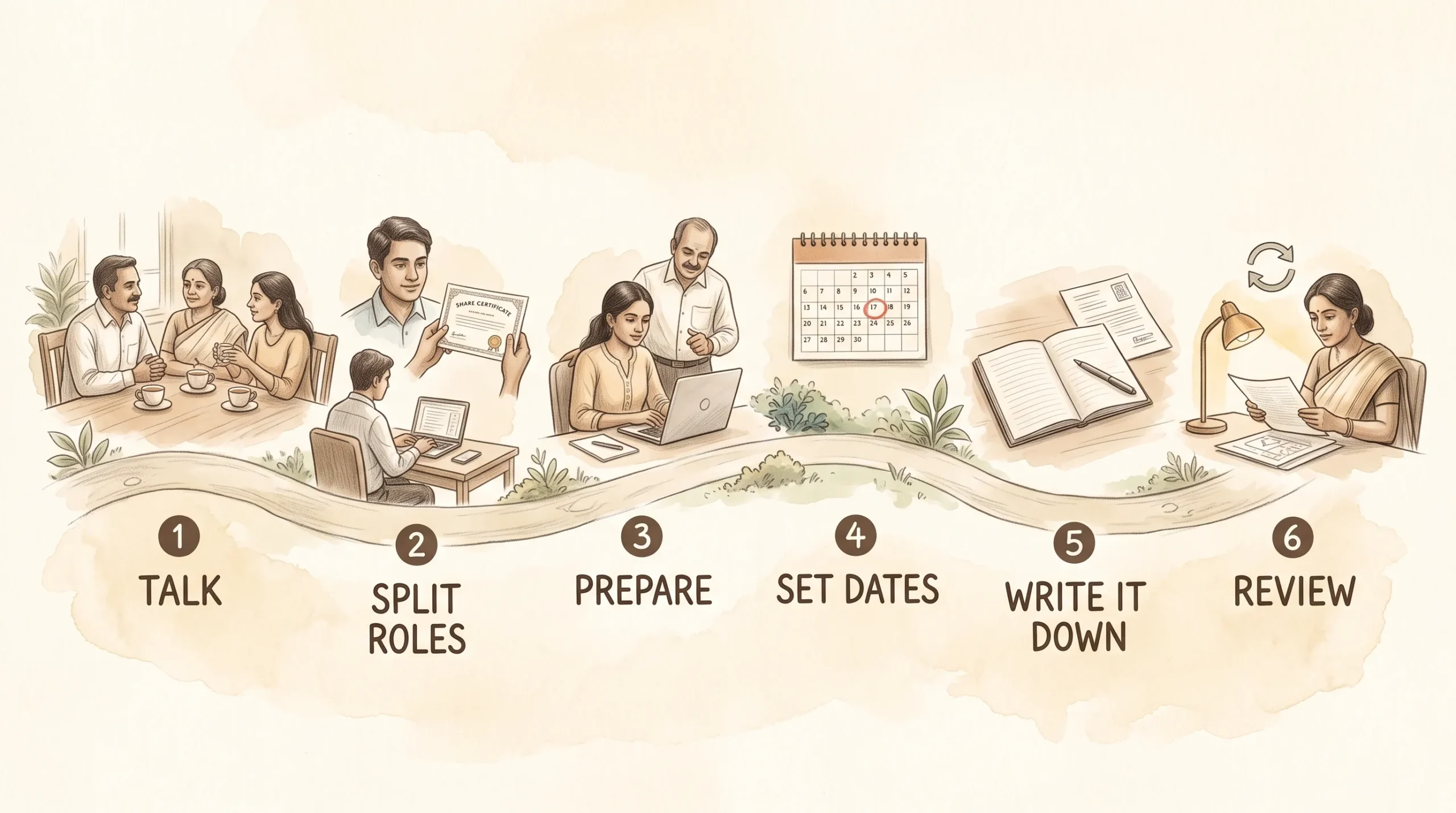
There is no single formula. But most strong plans do these things.
1. Start with talking
Each person says what they want. The founder, each child, and the spouses who live with the result. Many plans fail because nobody asked.
2. Decide ownership and leadership separately
Shares can stay equal. The leader still needs to be one person. If you want to see how families do this, read Succession in family business: how to hand over control step by step.
3. Prepare the people
A successor needs real work, real decisions and often experience outside the family firm. A title alone prepares nobody.
4. Set dates
"One day" is not a date. A plan needs a first handover date and a second one.
5. Put it in writing
Write down the family's agreement. Then ask your CA and lawyer to turn it into the right shareholding and legal papers.
6. Review it every year
Families change. Children marry. Interests shift. A plan from five years ago may no longer fit.
Why many plans stay on paper
Nothing breaks on the first day. The cost arrives slowly.
The plan is never discussed. It sits in a drawer. The children learn about it from a lawyer, after the founder is gone.
The date keeps moving. The answer to "when?" stays "not yet."
The successor has the title but no authority. Every real decision still goes back to the old desk.
The family hears surprises. People who were never asked feel they were never counted.
Deloitte's 2026 global survey of 1,587 large family businesses found that 82% have some form of succession plan. But only about half call their plan thorough and well developed. These are large businesses from many countries, so treat the figure as a guide and not as an Indian number.
The gap between "having a plan" and "having a working plan" is where most families struggle. Sandeep writes about this in Why family business succession planning fails in India.
Who needs a succession plan, and when to start
Every family business needs one. A small shop needs it as much as a large group.
Start earlier than feels necessary. The best time is when the founder is healthy, the family is calm and nobody is under pressure. A plan made in a crisis is made in a hurry.

Questions to sit with
Answer these alone, and preferably in writing.
- If you stepped back tomorrow, who would own the business and who would lead it?
- Is your plan written down, and does your family know what it says?
- Have you asked each child what they want, or only assumed?
- What is the date of your first real handover?
- On that day, would your successor have real authority, or only a title?
The last question is the hardest. It shows whether you have made a plan, or only a document.
Frequently asked questions
What is succession planning in simple words?
Succession planning is deciding, early and clearly, who will own and who will lead a business after the founder steps back. It also means preparing those people so they can do the job. In a family business, it includes talking to the family, because everyone is affected by the decision.
What is the difference between succession planning and a will?
A will decides who receives assets after a person's death. Succession planning starts while the founder is alive. It covers who will lead the business, how the next generation gets ready and how the family stays together. A will can be one small part of a succession plan.
Why is succession planning important for a family business?
Without a plan, decisions stall and the family often argues about who should lead. Staff and customers become uncertain. A clear plan protects the business and the relationships. It also gives the next generation time to learn, instead of being pushed into the role suddenly.
When should a family business start succession planning?
Start years before the founder wants to step back. The best time is when the founder is in good health and the family is calm. A plan made after a health scare or a family fight is usually rushed, and it often leaves people feeling unheard.
Who should be part of succession planning in a family business?
The founder, the children who may own or lead, and the spouses who are affected should all be heard. Senior non-family managers often need to know too. Your CA and lawyer help with the legal side. A neutral advisor can help the family talk openly.
A plan is a conversation, not a document
Most families treat succession planning as a task. They sign something and feel finished.
The families who do it well treat it as a conversation. They keep having it, year after year.
If this conversation has waited in your family for a long time, Sandeep works with business families on exactly these questions. Learn more about his Family Business Succession advisory or bring one question your family has been carrying.
The papers can wait. The conversation cannot.
About Sandeep Amar Guppta
“Inheritance Is Not Succession” is the philosophy at the heart of Sandeep Amar Guppta’s work. He challenges how families think about succession, focusing on what is often overlooked: the human dynamics of leadership transitions, the difficult conversations needed to resolve intergenerational conflict, and what it takes to build a lasting legacy.
Drawing on 45 years of experience, Sandeep created The S.H.E. Framework™, integrating the spiritual, human and economic dimensions of leadership and business.
A Fellow Chartered Accountant, he guides clients to explore how money, purpose and human behaviour interact. He helps founders, leaders and organisations, within and beyond family businesses, align purpose, people and performance to remain relevant, productive and profitable.
Work with Sandeep: https://sandeepamarguppta.com/work-together